



Stable bedding rarely feels like one big expense. It is a few bags this week, a pallet next month and another top up when a wet or messy horse has gone through more than expected. But every bag has to be bought, stored, spread, mucked out and dealt with again. Across a full year, especially when you have several boxes, that quiet weekly routine can become one of the biggest ongoing costs in the yard.
The good news is that spending less on bedding does not have to mean skimping on your horse’s comfort. Once you look at the jobs the bedding is doing, there are practical ways to use less of it. The right permanent floor underneath can make a much bigger difference again, with quicker cleaning, less maintenance and less soiled material to shift or dispose of.
In this guide, we’ll work out what your bedding is really costing, where it may be going to waste and which parts of the job a better floor can take over. We’ll also look at realistic savings, easier cleaning and the flooring choices that can turn a weekly consumable into a much smaller, more manageable expense. Most importantly, your horse will not be left standing or lying on a hard floor.

Why do stable bedding costs climb so quickly?
One bag or bale never looks too bad at the time. The real bill shows up when you multiply it by every week of the year, then by every stable.
Here is a quick way to do the sums:
|
Your annual bedding cost Delivered cost per bag or bale × units used per week × 52 × number of stable boxes |
Take a 4 m × 4 m box and use $22 per bag as a simple working figure. One bag a week is $1,144 a year. Two bags is $2,288. Three bags is $3,432. Across four boxes using two bags each per week, the annual spend is $9,152. That is before delivery, storage, mucking out or disposal.

Figure 1. Bedding spend compounds quickly. The chart uses a $22 bag only as a worked assumption.
There isn’t one honest ‘bags per horse’ figure that suits every yard. A tidy horse on an absorbent bed may use far less than a wet or messy horse that spends longer in the box. Climate, floor fall, drainage, bedding depth and the way the box is mucked out all matter. Read through genuine owner discussions and the same story comes up again and again.
Some boxes need only a light weekly top up, while others chew through several bags. A record from your own boxes over eight to twelve weeks will tell you far more than somebody else’s average.
What is the bedding actually doing?
A stable bed normally has two main jobs:
· Comfort for the horse: cushioning, insulation and protection from a hard or abrasive base.
· Keeping the box clean: absorbing urine, keeping the lying area clean and making manure and wet material easier to remove.
On bare concrete, the bedding has to do both jobs at once. That is why many owners keep a deeper bed for softness as well as absorption. When the floor itself provides more cushioning, you can use the bedding where it is really needed, for moisture control, a clean lying area and the way your horse prefers to rest.
|
The useful distinction Using less bedding does not mean leaving the box bare. The aim is to replace some of that disposable cushioning with permanent support, while keeping enough clean, absorbent bedding for the horse and the way the stable is managed. |

Five ways to waste less bedding before changing the floor
- Track each box on its own. Record the bags added, the wet bedding removed and the days the box was occupied. One messy horse can throw out the figures for the whole yard.
- Match the bedding to the horse and the box. Absorbency, dust, bag weight, composting, local supply and your horse’s habits can matter more than the shelf price.
- Be consistent with mucking out. Take out the manure and wet spots without routinely throwing clean bedding onto the muck heap. When several people share the job, a consistent routine can make a surprising difference.
- Fix moisture at the source. Check roof leaks, drinkers, floor fall, drainage, ventilation and material collecting under joints. No bedding system works well over a persistently wet base.
- Buy in bulk only when it genuinely saves money. A pallet can work out well, but freight, unloading, dry storage and damaged or damp bags all count.
These changes can trim waste, but they do not solve the main problem. If bedding is still providing most of the cushioning over a hard floor, you’ll keep paying for a comfort layer that is eventually thrown away.
The hidden cost is bigger than the bedding invoice
Every bag you carry into the stable eventually has to come back out, usually mixed with manure and urine.
That means work and cost at both ends:
· ordering, delivery and unloading
· dry storage and moving bags to the stable
· spreading, topping up and levelling beds
· daily mucking out and wheelbarrow trips
· muck heap space, composting, removal or disposal
If you want to put a real value on labour, time the current routine for a fortnight and compare it after a change. Fewer bags and less soiled bedding can mean much less carrying, mucking out and barrow work, especially across several boxes. The exact saving depends on your horses, staff, yard layout and what you do with the waste. We have left labour out of the bedding calculation above so the figures stay honest.
When does the floor start saving you money?
Once you have the avoidable waste under control, the floor is the part that can change your costs for years, not just a few weeks. A floor made for horses can provide permanent cushioning, insulation, grip and a cleaner base to work from. Bedding no longer has to be the only soft thing in the box.
This is where REGUPOL is worth a closer look. It is not simply a piece of rubber laid down over the base. It is an equine flooring system chosen to suit the horse, the existing floor, the drainage, the way you clean and the amount of bedding you want to keep using.
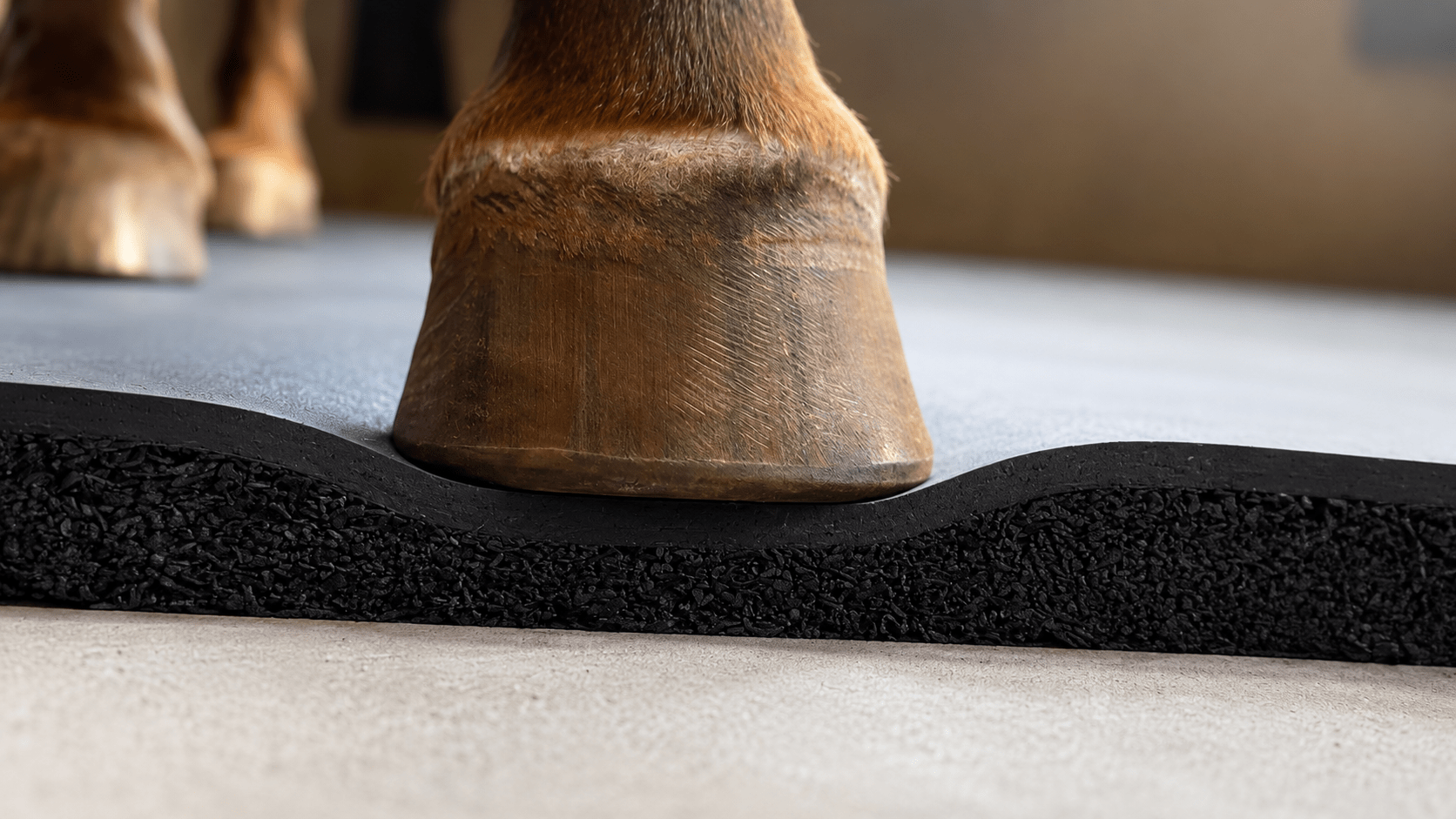
 Image above: REGUPOL Equiline Stable - 40mm
How does REGUPOL reduce stable bedding use?
REGUPOL equiline flooring is made for horses and the way horse areas are used. Its permanent elasticity gives the horse a much more forgiving surface than bare concrete or natural surfaces like crushed rock and clay. It also provides high slip resistance, with options for fixed floors, heavy loose laid tiles and installations where drainage is a priority.
Because the floor does much of the cushioning and insulation work, the remaining bedding can be kept for absorption, hygiene and the individual horse if required.
In the right stable setup, REGUPOL equiline systems can reduce the bedding normally required by more than 75%.

Figure 2. Worked REGUPOL scenarios for one stable currently spending $2,288 a year on bedding.
At 25% less bedding, that example saves $572 a year.
At 50%, it saves $1,144.
The 75% upper scenario saves $1,716.
These figures are for one stable only.
This covers bedding only. Fewer bags to handle, less material to muck out and a smaller waste pile can add another worthwhile saving, but it is best to measure that separately in your own yard.
|
Simple payback formula Total supplied and installed flooring cost ÷ verified annual bedding saving = simple payback in years. Use an actual REGUPOL quote and your own bedding record. A generic price from the web may not give you a useful answer. |
Can REGUPOL reduce bedding to a very light layer?
Yes, REGUPOL provides permanent cushioning and insulation, so owners can often move away from a conventional deep bed and keep a lighter absorbent layer over the usual wet spot or where the horse likes to lie if required.
Wash bays, aisles, tie-up areas, and other places where horses do not sleep generally need no conventional deep bedding. In overnight boxes, foaling boxes, recovery boxes or boxes for older horses, a clean absorbent top layer is usually the best balance for urine control and lying comfort. REGUPOL takes away much of the need to use bedding as throwaway cushioning, while still letting you manage moisture around the individual horse.

Why choose REGUPOL instead of a generic rubber mat?
REGUPOL equiline options are designed for equine use. Generic vulcanised or natural rubber mats may have been made for industrial floors, gyms or general use. A rubber pattern or a dimpled pattern does not tell you whether the floor will suit a horse. What matters is the cushioning, weight, fit, performance when wet and the way the floor is installed in your stable.
|
What matters |
How REGUPOL handles it |
What can go wrong with the wrong mat |
|
Comfort under hoof |
Permanent elasticity and a choice of thicknesses made for horse areas. |
A dense, hard mat may cover the concrete but still leave you needing a deeper bed for comfort. |
|
Stays put |
Bonded floors or heavy, properly contained tiles are chosen to suit the base. |
Thin or light mats can move, gap, curl or lift when the product, fit or edge restraint is wrong. |
|
Grip when wet |
The surface is chosen for equine areas, then supported by proper cleaning and drainage. |
Dimples or a pattern do not guarantee wet grip. Dirt, hardness and wear still matter. |
|
Cleaning |
The joins, edges, base and cleaning access are considered as one complete floor. |
Moving mats or open joins can let urine and bedding underneath, which means more cleaning and maintenance. |
|
Bedding use |
The floor does more of the cushioning and insulation, so bedding can focus on absorption. |
If a mat stays hard or moves under hoof, you may find yourself using just as much bedding. |
For a fuller explanation of the comfort difference, see What Is the Most Comfortable Equine Flooring in Australia? and our practical guide to affordable stable flooring choices.
Which REGUPOL floor suits your stable box?
There isn’t one best REGUPOL floor for every stable. The right choice is the one that suits your horse, the existing base and the job the floor needs to do. It is not simply a matter of choosing the thickest product on the list.
|
REGUPOL floor |
When it makes sense |
How it is installed |
|
A great fit when you want a lower profile, professional surface in boxes and connected horse areas, with a fixed finish that is easy to clean. |
A roll that is glued down over a suitable prepared hard base. |
|
|
A lower profile tile when you want more forgiveness than a hard base and some flexibility in how the floor is installed. |
A tile that can be loose laid or glued down, depending on the base and edge restraint. |
|
|
More depth and cushioning in a fixed tile for stable boxes and other busy horse areas. |
A tile that is glued down over a suitable prepared base. |
|
|
A high comfort option when you want substantial cushioning and a heavy tile that sits securely. |
A heavy 2 m × 1 m loose laid tile for crushed rock/ natural bases or hard bases like concrete. |
|
|
The stable box specialist when comfort, drainage and a major reduction in bedding are the priorities. |
A 1 m × 1 m tile with a studded underside, designed with drainage in mind. For crushed rock/ natural bases or hard bases like concrete. |
A bonded floor can give you a secure finish that is easy to clean, with fewer places for bedding and urine to work underneath. A heavy, loose-laid floor or a drainage-focused system is best for crushed rock/natural bases and stables where the owner wants to loose-lay rather than glue down.

Is REGUPOL worth it for reducing bedding costs?
If you expect to keep using the stable for years, REGUPOL makes a lot of sense. You buy the flooring once, rather than paying over and over for bedding to do all the cushioning.
That means less bedding to buy, carry, spread, muck out and dispose of. It also gives your horses a more cushioned, supportive, quieter surface and gives you a box that is easier to manage.
The saving is usually easiest to see when bedding use is high, you have several boxes, waste is difficult to deal with or there are never enough hours in the day.
You still need the right REGUPOL product over a sound base. A cheap mat that shifts, curls or stays hard under hoof can be false economy. It may create more maintenance and leave you using the same deep bed.
A correctly chosen REGUPOL system is built to do the flooring job properly and keep earning its place long after the first pallet of bedding is gone.
Find the right REGUPOL floor for your stable
Every stable is a little different. The right REGUPOL floor will depend on your existing base, how the area is used, the level of comfort you want and your available budget.
Whether your current surface is concrete, asphalt, crushed rock, compacted dirt or another natural base, our team can recommend the REGUPOL products best suited to your project. We can also provide product pricing, delivery costs and an indicative quote.
REGUPOL delivers to locations across Australia.
What information should you send us?
To help us recommend the most suitable options, please provide:
• The number and dimensions of your stable boxes or other horse areas
• Your existing floor or base
• Your delivery suburb and postcode
• Your preferred product or approximate budget, if you already have one in mind
You can reach the REGUPOL Equine Australia team by selecting the Get a Quote button on any product page, emailing sales@regupol-equine.com.au, completing our online contact form or calling 02 4624 0050.
Tell us what you are working with and we will give you clear product options, pricing and delivery information.
A note about the savings examples
The $22 bag price and the savings shown in this article are worked examples to help you compare your own costs. Bedding use varies between horses, stable setups and management routines. Use your own bedding records when estimating the reduction that may be possible in your yard.